
05/03/20, 12/03/20 and 19/02/20
Indian cinema has always been an influencer when it came down to our emotions, perspective towards the world and literally everything one can think of. The way the drama rises, mysteries trigger us, suspense attacks, story make us eager, Bollywood always makes us fall in love with it more and more.
The second project for Time has to be done in groups. I am a part of group of 5. The first task assigned to us was to watch 5 movies together and build up 5 mind maps for each movie by deconstructing each one of them into different categories like plot, dialogues, songs, characters, figures of speech, era’s perspective, theme, set etc. We got 5 movies from the era- 1966-1980. As the classes was shifted to the online platform due to precautions taken to prevent us from the Covid-19 virus, all 5 of us decided to take charge of one mind map, i was incharge of making one on Here i have listed the movies down:
-
Griha Pravesh (1979, Basu Bhattacharya)
-
Chitchor (1976, Basu Chatterjee)
-
Sholay (1975, Ramesh Sippy)
-
Mrigaya (1976, Mrinal Sen)
-
Manthan (1976, Shyam Benegal)
Hereby i have mentioned the pointers and personal analysis of the movie that have not been mentioned in the mind map except for the plot. Character analysis, themes, dialogues, set etc. has already been mentioned in the mind map and thus, has not been repeated.
1. Griha Pravesh (1979, Basu Bhattacharya)
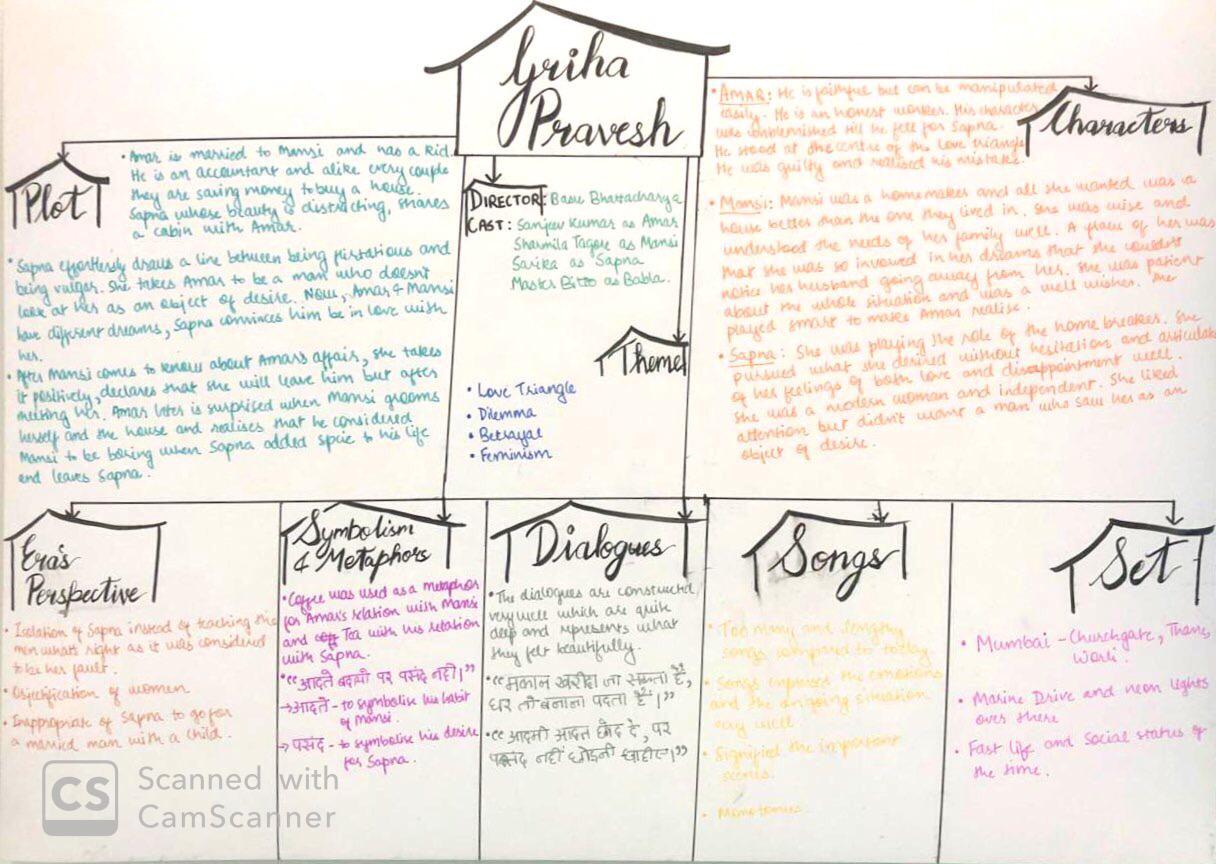
Main Characters: Sanjeev Kumar as Ama, Sharmila Tagore as Mansi, Sarika as Sapna
Side Characters: Master Bittoo as Babla (child)
Plot: (Not repeated as the same is mentioned not he mind map, written by myself.)
Critics and analysis:
- The analogy of Coffee and Tea as wife and girlfriend respectively, being the center of movie is awesome.
- It was a three sided love story with no sinners.
- Portrayal of the affair was very subtle and gentle.
- Irresponsible of Sapna to be involved in her own dream of buying a house that she let Amar go away form her.
- Intensity of the dialogues deserves a remark. The dialogues were exceptionally good and expressed a hundred feelings of the character in just a sentence.
- Advertisement of Nescafe and Glucose.
- Gave us a contemporary picture of a marriage ahead of its time.
Societal issues and Era’s perspective:
- Orthodox mindset of people considering it be Sapna’s fault when everyone kept looking at her instead of wokring and shifted her to Amar’s cabin instead of teaching the men of their office a lesson that it’s their fault to have a perspective like presented.
- Feminism portrayed through Sapna’s character as she was an independent woman who was good at her work.
- Appropriate of a mother to want her child to study and become successful as she wasn’t able to complete her education.
- Inappropriate of a girl to try to get with a married man.
- The film was shot based on a modern concept ahead of its time.
2. Chitchor (1976, Basu Chatterjee)
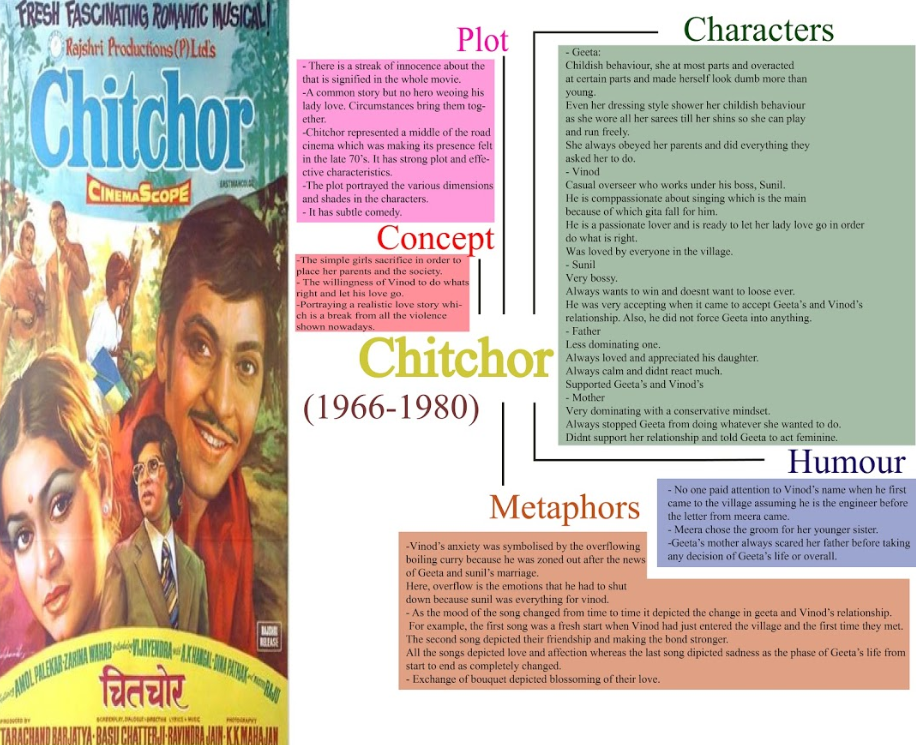
Main Characters: Amol Palekar as Vinod, Zarina Wahab as Geeta P. Choudhry, Vijayendra Ghatge as Sunil Kishan and A. K. Hangal as Pitamber Choudhry
Side Characters: Ritu Kamal as Meer and, Master Raju as Deepak Kumar Agnihotri
Plot:
The story starts with Pitambar’s older daughter Meera writing him a letter which read that she knows a perfect boy who is an engineer for marriage with her younger sister Geeta and she also mentioned that he would soon be coming to visit them.
Vinod comes to the viallage and adapts to everything very well. He even easily earns Geeta’s heart. Everything this was going exceptionally good until the unexpected twist come in the movie afte rthe arrival of Meera’s second letter where she mentions that the engineer she chose for Geeta would arrive soon as he wasn’t able to come earlier. This leaves everyone stunned when Geeta reads the letter out and everyone is left in the mystery of who the other guy is.
Soon, Sunil, the engineer mentioned by Meera arrives and Geeta is ordered by her mother to forget everything about Vinod and get ready to get married with Sunil. Geeta being a dutiful daughter listens to her mother and ends her contact with Vinod. On the other hand Vinod is still not aware of what is going on.
Later in the movie, Vinod is shattered as on a picnic he finds out that Geeta is going to marry Sunil and not him. Vinod plans on returning back to Mumbai after his heart breaks. Even though Geeta listened to her mother, her love for Vinod was’t over and thus, she goes to the station to stop him but couldn’t find him.
The movie ends at a surprising turn of events. When heartbroken Geeta returns home sobbing and all lost in the grief of losing Vinod she is surprised to see Vinod waiting for her in her house. Then, like every other fairy tale they get married and live happily ever after.
Critics and analysis:
- Stereotypical romantic film, the plot like other fairy tales.
- Quite predictable after the twist.
- Irresponsible parental qualities to just look for money and social status of a man to be eligible to marry their daughter, Geeta.
- Transformation of Geeta from a fun loving extrovert to a silent introvert.
- The song, “Gori tera gaon bada pyaara”, aesthetically bought out the beauty of the village indirectly while Vinod praised Geeta.
- Scenes ended and new ones started quite abruptly which broke the flow of the movie at times.
- Amazing way of portraying Vinod’s anxiety by the boiling curry and the various mishaps that took place with the food.
- Geeta being a dutiful daughter and only disobeys her parents when it came down to her freedom.
- Over confidence show in Sunil’s character when he overtakes the car.
- Feminism portrayed in Geeta’s character when she wanted to study instead of getting married.
Societal issues and era’s perspective:
- Marriage of girl just after she passed 10th class.
- Orthodox mindset of her parents and sister to consider a man perfect to marry her if he earns well. But this is justified if we look at the era.
- Difference between the economic status of a village and a city was shown when Vinod’s car came form Mumbai and was punctured twice and also sights of Geeta and her family at the arrival of the car.
- Domination of wife when it came down to decisions was a factor which wasn’t totally justified on the basis of the presented times.
3. Sholay (1975, Ramesh Sippy)
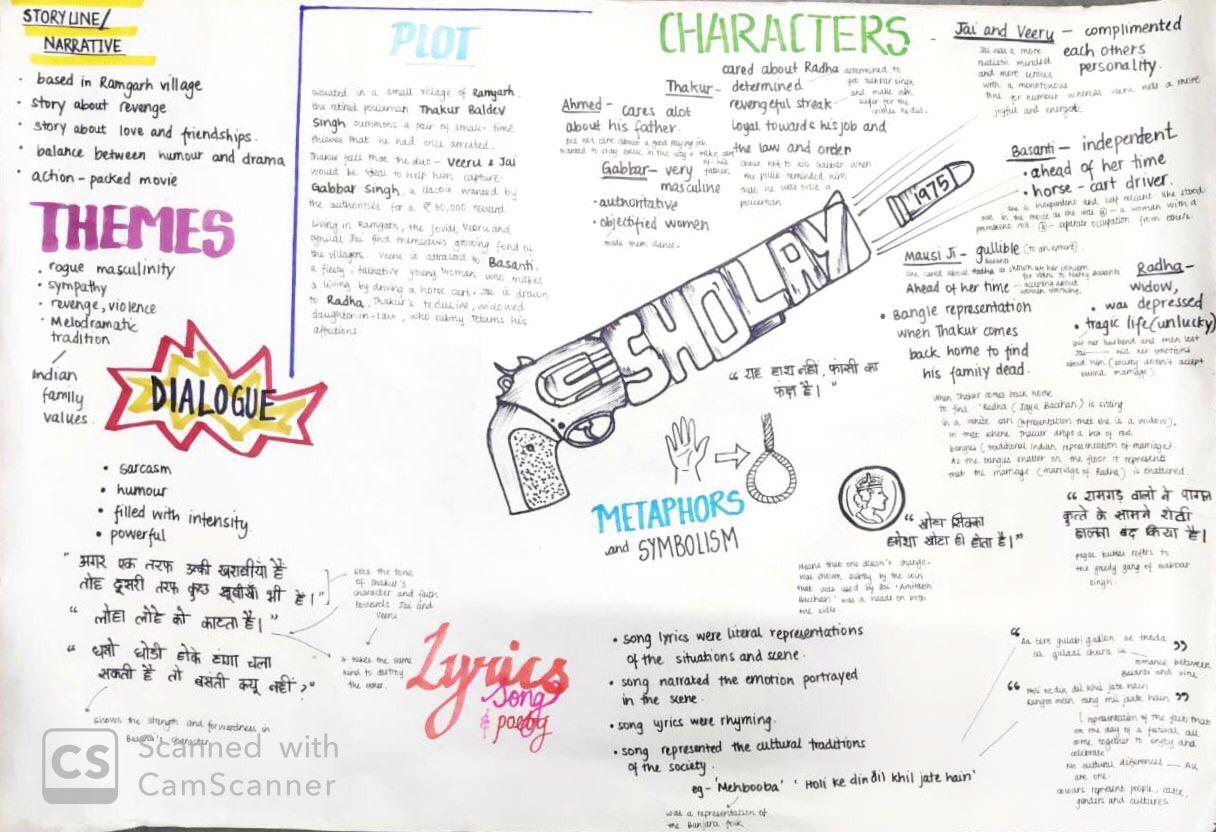
Main Characters: Dharmendra as Veeru, Amitabh Bachchan as Jai, Sanjeev Kumar as Thakur Baldev Singh, Hema Malini as Basanti, , Jaya Bhaduri as Radha and Amjad Khan as Gabbar Singh.
Plot:
Sholay is considered to be one of the most iconic films of that era. The main element which made the movie iconic was the friendship and the bond of Jai and Veeru in the film and this was the major point of attraction for me in the movie.
The two best friends, Jai and Veeru are presented as criminals who are not easy to catch, later then they are hired by a police officer, Thakur to capture the ruthless Gabbar Singh who was into banditry.
In the movie, there is also an element of chemistry which eventually evolves into the love story of Basanti and Veeru and later in the movie Jai and Radha too. Tragedy in the movie begins when Thakur loses all the members of his family except Radha who were killed by Gabbar, to take revenge he then rushes toward Gabbar and ends up in a terrible situation when Gabbar cuts down both of his arms. To take back what he lost, Thakur hires Jai and Verru to get back at Gabbar as he wasn’t capable of doing that.
Later in the movie due to the conflicts between Gabbar’s gang and Jai-Veeru leads to Gabbar capturing Veeru and Bassanti. Thus, Jai revolts with an attack at the gang and this is when he sacrifices his life to save Veeru and Basanti and send them to call for backup. This triggers Veeru’s anger and emotions who then attacks Gabbar and manages to gain control over him, nearly beating him to death but as it was earlier clearly stated by Thakur when he hired them that he wants Gabbar alive.
The movie ends when police take Gabbar Singh away while Basanti and Veeru begin a new life carrying the grief of Jai’s death.
Critics and analysis:
- Exclusive dialogues and use of figures of speeches. Eg “Yeh haath nhi, phaasi ka phanda hai.” and “Khota sika hamesha khota he hota hai.”.
- The love of Jai for Veeru shown at every step when he uses the same-faced coin and always keeps his best friend before him even when it came down to the matter of life and death.
- Exclusive blend of tragedy, emotions and drama.
- The background music and songs added a special touch to the important scenes.
Societal issues and era’s perspective:
- Feminism portrayed in Basanti’s character. She was an independent women, worked hard all day, had courage to fight the enemies irrespective of what people expected of a girl in those days.
- Banditry was portrayed in the film by Gabbar and his people.
- Exploitation of the villagers.
- Due to the circumstances of the villagers and threat of Gabbar, responsible character of Jai and Veeru emerges out.
- Somwhere, Jai knew that if he stayed alone to fight Gabbar’s army, he would end up dead but still his love for Veeru gave him the courage to take such a step and move towards his own death.
4. Mrigayaa (1976, Mrinal Sen)
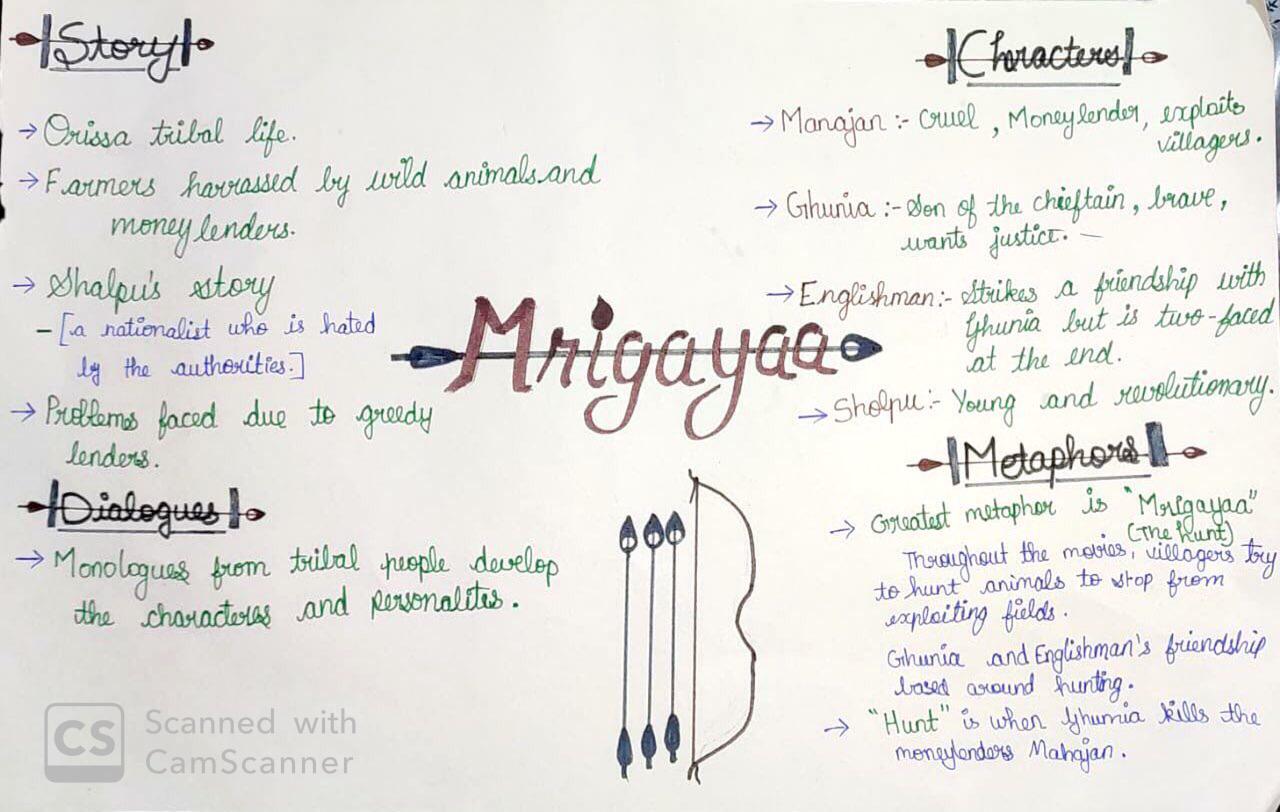
Main Characters: Mithun Chakraborty as Ghinua and Mamata Shankar as Dungri
Side Characters: Robert Wright as the British administrator
Plot:
Mithun, the human beast, the mean money merchant who eyed the women folk. He is a hunter by nature, his big catches attracting big rewards from the British administrator (Robert Wright), who spent many years in old Calcutta.
The British administrator admires Ghinua as a splendid hunter. Ghinua is part of a world that believes in simple living, even if in eternal debt. They fight the plundering beasts, man and animal, who destroy their crops.
Ghinua is the dreamer of this dream. He can distinguish between the loving and caring British national and the scheming Indian who kidnaps his wife, only to be slayed by Ghinua, who is promptly sent to the gallows.
The end is quite disturbing where Ghinua questions the methods of justice, death for killing a tyrant but not when one of his villagers shoots a rebel.
The tribal villagers suffer in silence at most times but promptly unite to protect Bhanja from being taken away by the police. He represents the rebellion against the British, and the united backing from his village folks is a reflection of the changing times, the masses rising to free the country.
In Ghinua’s death, the village folk, led by Dungri, come to discover the way to fight, to be counted in their own simple manner.
Critics and analysis:
- The tribal aspect of that time was quite impactful on the audience.
- The costumes of the entire cast were quite simple which represented simplicity of the time.
- The monologues by the tribal peopel in the movie were influencing.
- Throughout the movie, the main focus of villagers was to stop the wild animals from exploiting their fields by hunting them down which was the biggest hunt for them. But the greatest hunt was when the moneylender, Mahajan is killed by Ghunia.
Societal issues and Era’s perspective:
- Banditry was portrayed in the film by Gabbar and his people.
- Exploitation of the villagers.
- Harassment of the poor by the money lenders.
5. Manthan (1976, Shyam Benegal)
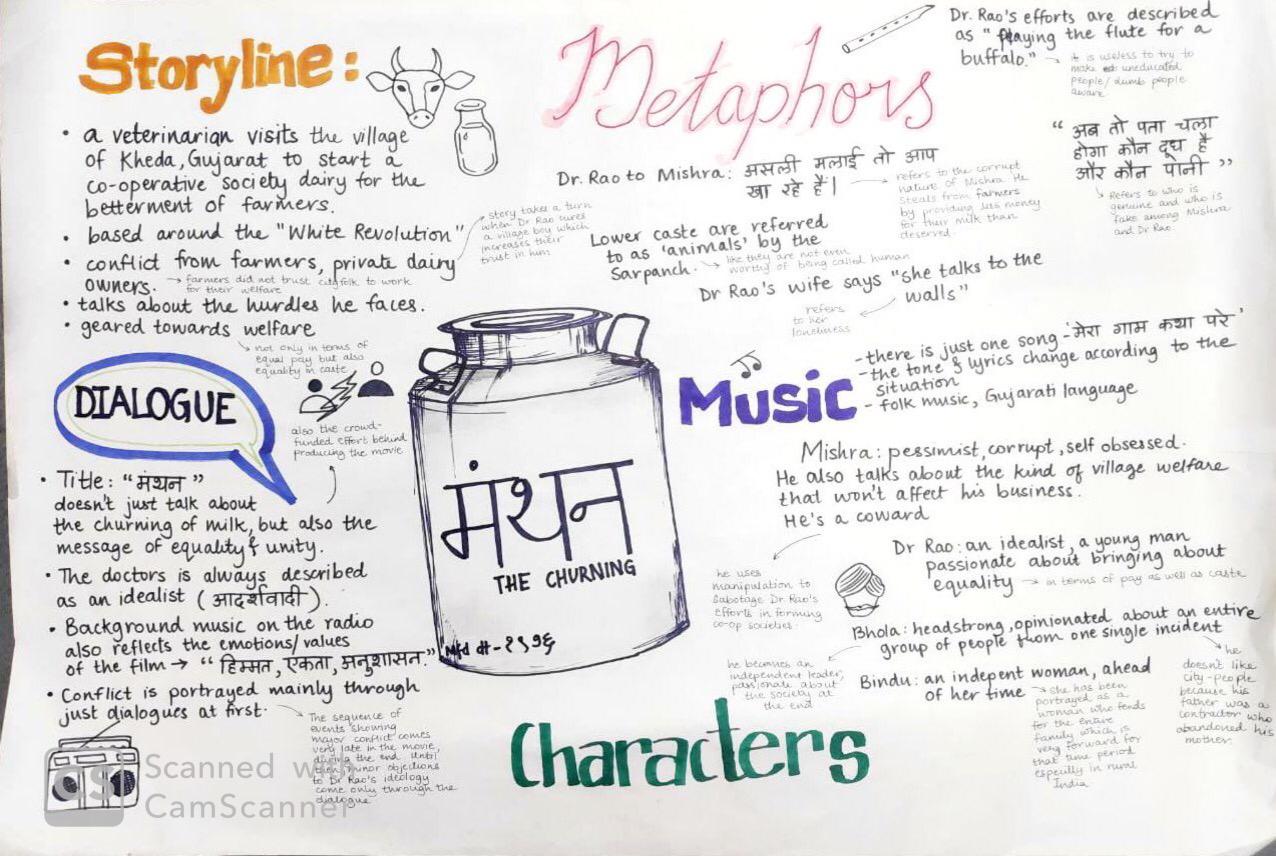
Main Characters: Girish Karnad as Dr. Rao, Kulbhushan Kharbandaas Sarpanch, Smita Patil as Bindu and Mohan Agashe as Deshmukh
Side Characters: Amrish Puri as Mishraji, Rajendra Jaspalas Bindu’s Husband, Abha Dhulia as Shanta, Dr Rao’s Wife and Naseeruddin Shah as Bhola
Plot:
The film traces the origins of the movement through its fictionalized
narrative, based around rural empowerment. The prime livelihood of the villagers is cattle rearing and they sell the milk to a local dairy owner Mishra Ji, who does not pay them fairly for the milk.
A young veterinary surgeon, played by who joined hands with local social
worker, Tribhovandas Patel, which led to the setting up a local milk
cooperative, in Anand, Gujarat.In the film, Dr. Rao, comes to a village, to set up a dairy which will be owned and managed collectively by the villagers themselves, giving them a fair chance to work together and increase their living standards.
This also challenges also the age-old feudal structure of the village. The first adversary that the team faces is the politcs of the village and exploitation. Resentments form a rigid caste system combined with general lack of mutual trust leads to the dalits of the village, led by Bhola, as well as the Panchayat head leads to hostilities. However, the womenfolk of the village are determined to better their lives and take initiative, led by a vocal Bindu. Slowly Dr. Rao and Bindu get attracted to each other.
When Dr Rao assures fair payment to the villagers for their milk and starts earning their trust, this irks Mishra Ji who starts plotting against him. The politics in the village escalates and Bhola defeats the Pramukh in the elections to become the Village Head. A snided Pramukh sides with Mishra Ji and starts conspiring against Dr. Rao. Aided by Bindu’s husband, they force her to make an allegation in the Panchayat that Dr. Rao has raped her.
Extremely saddened by the turn of events, Dr. Rao decides to complete the remaining work of the Co-operative and exit the village. Bhola however carries on the work with the help of villagers, notably Bindu, yielding fruit to the brave efforts of Dr. Rao.
Soon an uprising is sparked among the local untouchables, which leads
to an economic revolution as well.
Critics and analysis:
- Portrayal of the real rural life.
- Portrayal of the problems faced by an entrepreneur.
- Portrayal of poverty through repetition of clothes
- the foundation of success was courage, unity and self-reliance.
- Social reconstruction of society developed a send of unity in the audience.
Societal issues and era’s perspective:
- Exploitation of the villagers.
- Exploitation of uneducated and lower caste women
- Feminism portrayed in Bindu’s character by working instead of just managing the household.
- Existence of wedges between the villagers due to different castes.
- Prejudice of rural people that they tend to have towards urban people and vice-versa
The 2 most common elements i found in all these 5 movies were:
- Portrayal of feminism, through female characters of the movie.
- The lyrics of all the songs was a true expression of the on going scene and the feelings of the main characters of the scenario. The lyrics of each song were like dialogues which instead of being used in a conversation were used in the form of songs. This element at that time was common unlike today’s time where it is quite different.
Other societal issues at the time like exploitation of the poor, caste discrimination and others were quite taken into consideration in every movie to try to make change int he society through the medium of cinema. It was a good step towards change as each one of us learn something or other from every film.
The first task ended here after deconstructing all of the movies and making the mind maps. It was a fun task not at all boring. I enjoyed watching the movies and really loved Sholay and Griha Pravesh, rest 3 were also good ones. Another learning part was discussing the movies with the other members of the group, this made me learn and notice some more factors of the movie, characteristics of the characters and elements which i didn’t earlier and also it was a good experience to look at a similar thing from different perspectives.

 Shreya's Blog